


Support: B1 Bluetooth Receiver
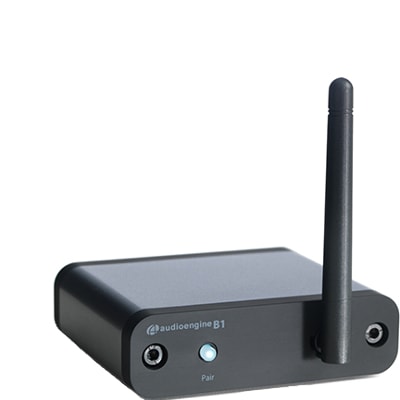
Support: B1 Bluetooth Receiver
Questions & Answers
-
Question:
Is the B1 compatible with TIDAL music streaming service?
Answer:The short answer is yes! You can use TIDAL on any compatible source device (PC, Mac, iPhone Android, etc.). The B1 is compatible with most all of these devices as well since they almost universally also include Bluetooth.
-
Question:
Will the B1’s range work between more than one room?
Answer:The overall range you can expect will vary depending on the device you use with the B1. We tested using mostly a variety of smartphones though, and found 100 FT to be a realistic expectation, and that's through one wall.
-
Question:
Can I change the name of my B1?
Answer:It depends on the device it is connected to. Most Android devices and computers can rename the device, but only for that specific connection. The B1 will still show as Audioengine B1 to a different device. You may also be able to change the name when using Apple products, but it will depend on the operating system.
-
Question:
How can I connect the B1 for my car audio?
Answer:You could use a B1 to stream Bluetooth audio in your car if you use USB power from either a cigarette lighter USB power adapter or USB port, and your car audio has an aux 3.5mm input. You can then pick up a RCA to 3.5mm adapter for the connection and the B1 will be ready to pair to your device/play through the car stereo. Let us know if you have any other questions.
-
Question:
Why does my B1 have no power?
Answer:For starters, try pressing the Bluetooth LED on the front of the B1 to confirm it's not on. If the device that was paired with the B1 last is out of range or has been turned off, the light on the front of the B1 will turn off and remain off until the LED button is pressed.
From there, to assure it's not simply an issue with one of the accessories, swap out the USB cable and the USB AC adapter to see if that fixes things. If you have a micro USB cable laying around from an older cell phone model, you would be fine using that. And most current cell phone USB power adapters would work just fine with the B1.
If you have no success with either of the above, try plugging the B1 into a different power outlet to see how the unit reacts. If there is still no indication of the unit powering on, please contact our Support Team for further assistance.
-
Question:
B1 General specifications
Answer:Bluetooth receiver type
Bluetooth 5.3Supported Bluetooth codecs
aptX HD, aptX, AAC, SBCSupported Bluetooth profiles
A2DP, AVRCPInputs
BluetoothOutputs
Stereo analog RCA
Digital optical (SPDIF)Required power
5V, 200mAWireless operation range
Up to 100ft (30m) typicalFull-scale output
2.0V RMSOutput impedance
57 OhmsD/A converter
Wolfson WM8740Power filtering
3-stage redundant regulationSNR
SNR (DC to 20 kHz)
100dBTHD+N
(1 kHz FS 96 kS/s) <0.02%Frequency response
10Hz - 20kHz (+/-0.5dB)Crosstalk
>-86dBInput bit depth
24-bit (upsampled)Input data rate
Determined by BluetoothLatency
~30 milliseconds (ms)Product dimensions
3.5 x 4 x 1Shipping weight
1.0lbs (0.5kg)Shipping box dimensions
11 x 7 x 3Environmental Requirements
Operating temperature: 32° to 105°F (0°C to 40°C)
Storage temperature: -4°0 to 115°F (-20°C to 46°C)
Relative humidity: 5% to 95% non-condensingIncluded accessories
RCA audio cable (3ft/1m)
Power adapter with detachable cable
Microfiber bag
Setup guideTechnical Features
Supports all Bluetooth-enabled devices
High-fidelity Bluetooth with aptX transmission and extended range
Stream high-resolution 24-bit digital audio from the Audioengine B1 to any music system.
Includes built-in Wolfson WM8740 DAC for superior 24-bit upsampled playback
Aluminum case with audiophile-grade connectors
Analog and optical outputs
2.0Vrms maximum output levelExperience stunning audio quality with aptX HD coding, built-in 24-bit upsampling DAC, and extended wireless range.
DAC Characteristics
The B1 Bluetooth Receiver utilizes the Wolfson WM8740 DAC, widely known for its low noise and high fidelity. B1 is essentially an upsampling 24-bit Bluetooth DAC and will pad all bit depths internally to 24-bits, thus achieving a higher signal-to-noise ratio. Due to the WM8740's high signal-to-noise specs, the fact that the digital signal is converted (upsampled) to 24-bits and the added benefit of triple redundancy power source conversion and filtering, the B1 presents impressive low noise and low distortion characteristics with a noticeable improvement over other Bluetooth devices.Extended Range
Most Bluetooth implementations have very limited range, usually within just one room. But with careful signal management circuitry and antenna tuning, we offer a superior solution that will reach more than one room with no degradation in audio quality.High quality Bluetooth audio
The B1 features aptX HD coding which is an advanced Bluetooth audio codec that provides much higher-quality sound than previous versions. The B1 is backwards-compatible with all previous Bluetooth implementations as well, so you can wirelessly stream music from any device and still enjoy outstanding sound.Optical Output
B1 also functions as a wireless audio bridge from your device to your favorite DAC or preamp. Use the internal DAC with RCA analog outputs or connect the optical output into another DAC. -
Question:
How to Add Bluetooth to a Stereo Receiver or Amplifier
Answer:Adding Bluetooth to Your Stereo Receiver or Amplifier: A Practical Guide with the Audioengine B1
In the current landscape of digital music, the convenience and versatility of Bluetooth connectivity have become increasingly essential for music enthusiasts. Those with traditional stereo receivers or amplifiers often find themselves at a crossroads, seeking to bridge the gap between their cherished, high-quality equipment and the modern world of wireless audio streaming.
This scenario raises the question: How to add Bluetooth to a stereo receiver or amplifier without compromising on sound quality? Enter the Audioengine B1 Bluetooth Receiver, a product that has risen to become one of our best sellers, thanks to its significant improvement in audio quality over competing solutions.
Why Consider Bluetooth for Your Audio System?
The shift towards wireless audio streaming is driven by several factors:
- Convenience of Wireless Technology: Eliminating the need for physical cables, Bluetooth allows for a clutter-free and flexible listening experience. The ability to control music from a distance is not just about comfort; it's about integrating your audio system into a wireless world seamlessly.
- Access to a Wide Range of Devices: Bluetooth enables your stereo system to connect with a variety of modern devices, including smartphones, tablets, and laptops. This compatibility opens up a world of possibilities, from streaming services and digital libraries to podcasts and online radio.
- Ease of Use: The ability to control your music wirelessly means you can change tracks, adjust volume, and switch between devices effortlessly, all from the device in your hand.

The Audioengine B1: Enhancing Traditional Systems with Modern Technology
The B1 Bluetooth receiver allows you to cast music and other audio from your device and send it out to any music system, without losing any sound quality along the way—even to those extended ranges. It works great with those vintage systems that have been waiting in the wings.
The Audioengine B1 Bluetooth Receiver has earned its place as a top seller by addressing the common pitfalls of wireless audio. Here’s how:
- Better than CD Sound Quality: The B1 stands out from its competitors by delivering an audio experience that’s both clear and rich. It leverages advanced technology to ensure that the sound transmitted over Bluetooth is faithful to the original recording. The B1 delivers high-quality, extended-range, CD-like quality sound anywhere in your home.
- Simple and Universal Compatibility: Designed for hassle-free integration, the B1 connects easily with any stereo receiver or amplifier, making the setup process straightforward for all users.
- Reliability: The B1 is known for its stable and consistent Hi-Fidelity Bluetooth connection, ensuring uninterrupted music playback.
Implementing the B1 in Your Audio Setup
- Making the Connection: Link the B1 to your stereo system using the provided cables, connecting it to an available input on your receiver or amplifier.
- Powering the Device: Plug the B1 into a power source, readying it for use.
- Bluetooth Pairing: Activate Bluetooth on your device and select the B1 to establish a connection.
- Begin Streaming: Your stereo system is now equipped to wirelessly receive audio from a range of Bluetooth-enabled devices.
Advantages of the Audioengine B1
While the B1’s primary goal is to introduce Bluetooth functionality to traditional systems, its benefits extend further:
- Preservation of Audio Quality: One of the key strengths of the B1 is its ability to maintain the integrity and richness of your music, a feature that has been a significant factor in its popularity.
- Compact and Unobtrusive Design: The B1’s sleek and minimalistic design ensures it fits seamlessly into any audio setup without becoming an eyesore or occupying unnecessary space.
- Versatility in Use: The B1 is not limited to streaming music; it enhances the audio experience for movies, gaming, and other multimedia applications.
Just a few MORE reasons why you'll love the B1 Bluetooth Music Receiver:
- Easy setup, connects in seconds
- No network setup, no passwords, no hassle
- Extended-range wireless aptX-HD Bluetooth, reaches further with CD-like quality sound
- Connects to any music system
- Analog and optical outputs
- Bluetooth aptX LED indicator
- CD-like quality audio with aptX-HD Bluetooth
Conclusion
The addition of Bluetooth to your stereo receiver or amplifier represents more than just a technological upgrade; it's a step towards bringing your audio experience in line with the evolving digital world. The Audioengine B1 Bluetooth Receiver offers an ideal solution, balancing the need for wireless convenience with the uncompromised audio quality. Its success as one of our top sellers is a testament to its ability to meet the demands of discerning audiophiles looking to modernize their audio systems.